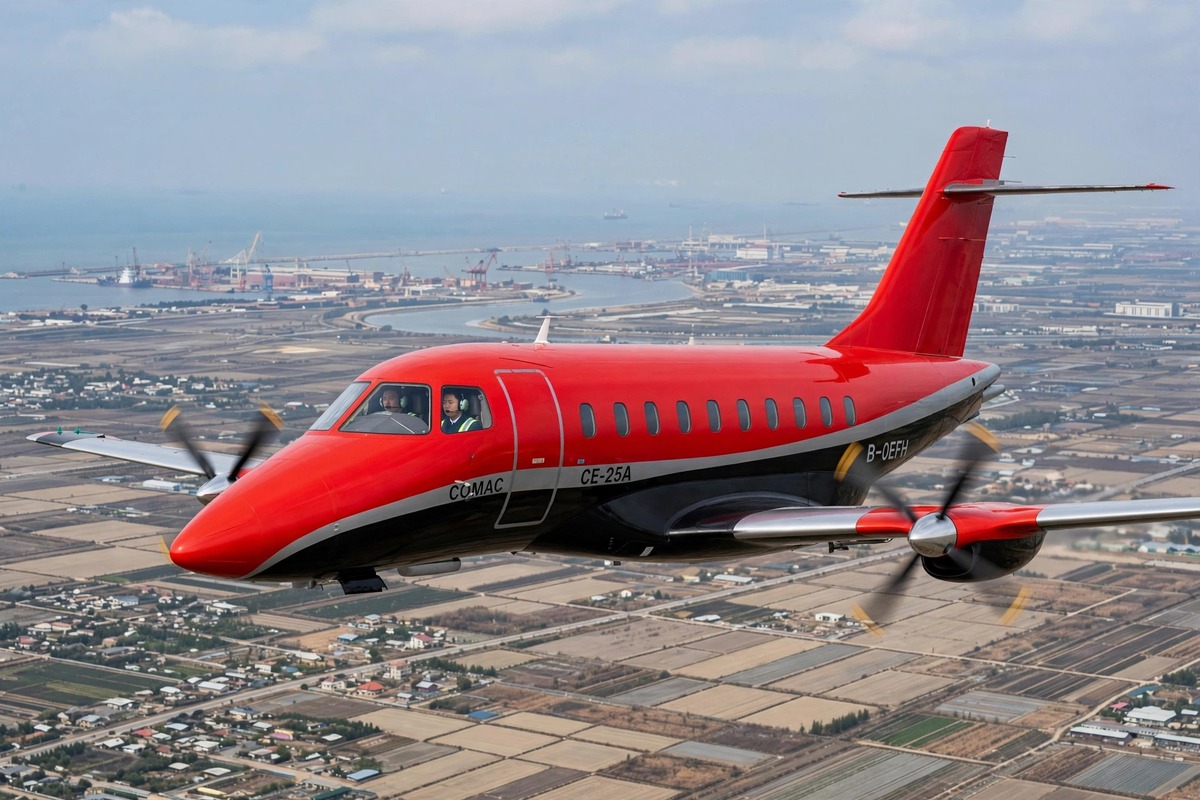
China Puts a Crew in the Cockpit
China’s state-owned planemaker COMAC has flown its all-electric commuter airliner with people aboard for the first time. On Saturday, two pilots and a flight-test engineer took the 19-seat CE-25A over Binzhou in Shandong Province. COMAC, which also makes the C919 narrowbody, said the aircraft operated normally and met its performance expectations. CCTV reported a flight lasting 16 minutes and 38 seconds over 60.4 kilometers. That is not a long trip, but test flights are about collecting evidence, not winning mileage contests. The flight followed the aircraft’s first autonomous outing on Feb. 2 and 19 uncrewed validation flights, according to COMAC.
China has completed the first test flight of its new CE-25A electric passenger aircraft in Binzhou, Shandong Province. The aircraft can carry up to 19 passengers and is designed to travel about 250 miles at speeds of up to 186 mph. pic.twitter.com/pl9Te2UlPU
— Breaking911 (@Breaking911) November 15, 2026
A Small Airliner With a Small Mission
The CE-25A is a 10-tonne-class electric commercial aircraft built mainly for intercity hops. It is rated for 19 passengers, a cruising speed of 300 km/h, a cruising altitude of 2,400 meters, and a range of 400 kilometers. Those figures translate to about 186 miles per hour and 250 miles. Ten electric ducted fans, five on each side, are mounted above the wing. COMAC first showed the design as a concept in Shanghai in November 2023, with a proposed range of 400 to 500 kilometers. Few people outside China knew a full-size airframe existed until photographs surfaced in late October. Aviation marketing loves a clean specification sheet. Batteries, however, remain stubbornly unimpressed by marketing.
China's domestically developed 10-tonne-class electric commercial aircraft, the CE-25A, successfully completed its first manned intelligent flight on Saturday in Binzhou, east China's Shandong Province. #ElectricAircraft #COMAC #ChinaAviation pic.twitter.com/7SBSSSOMX7
— China Xinhua News (@XHNews) November 14, 2026
The Battery Tradeoff Is Hard to Hide
The short range is the central tradeoff. A turboprop Beechcraft 1900 can carry the same 19 passengers about 700 kilometers at roughly 520 km/h. Batteries still store a small fraction of the energy contained in jet fuel by weight, which limits both range and payload. That makes the CE-25A a specialized short-hop aircraft rather than a simple battery replacement for every regional airliner. China is choosing a route where those limits may be manageable, then testing whether the aircraft can turn that narrow mission into a commercial one. Physics remains the least cooperative stakeholder in aviation.
China Keeps Going While Western Programs Change Course
COMAC has built a partnership around the project. CATL, China’s battery giant, Shanghai Jiao Tong University, and other partners helped develop the aircraft. The Civil Aviation Administration of China accepted COMAC’s application for a type certificate, opening the airworthiness review. That is a necessary step, not a service launch. No launch customer, price, or service date has been announced. The Western comparison is not flattering to Western programs: Sweden’s Heart Aerospace moved on from its 19-seat battery-powered ES-19 to larger hybrid-electric designs, while NASA’s X-57 Maxwell demonstrator was canceled in 2023 without flying. China is pressing ahead while other projects have changed course, and the contrast is hard to miss.
Washington’s Jet-Part Pressure Adds a Second Contest
Then there is the parts fight. COMAC’s jetliner business still relies on Western parts. The Commerce Department has been slowing export licenses for aircraft parts headed to China and limiting the number of parts licensed for shipment to COMAC, with the stated aim of preventing stockpiling. That pressure targets the jetliner business, while the CE-25A’s power partner is CATL, a Chinese battery company rather than a Western engine maker. The result is a split supply-chain picture. Export controls can make an existing program harder to support, while a domestic partner can give a newer program more room to develop. Neither point makes the CE-25A certified, cheap, or ready for passengers. It does show why parts policy and engineering are now sharing the same runway.
Why It Matters
This matters because the flight is not just about a new commuter aircraft. It tests whether China can connect batteries, autonomy, airframe design, and certification into a working commercial system. It also shows how supply pressure can split aviation into separate tracks: an existing business remains exposed to foreign parts, while a newer effort is built around a domestic battery partner. That distinction matters even when the aircraft’s range remains limited.
The people affected are broader than the engineers in the test program. Operators need to know whether the aircraft can serve useful routes, regulators must decide whether it meets airworthiness standards, and passengers would eventually face the practical limits of range and payload. The source leaves the biggest commercial questions unanswered: whether certification will arrive, whether a launch customer will appear, what the aircraft will cost, and when service could begin. Confidence is not a substitute for any of those answers.
The larger contest is about control of the tools needed to build and maintain aircraft. China is moving forward with a domestic battery champion while the United States is tightening access to some aircraft parts. Western projects have changed direction or stopped, while COMAC has moved from autonomous testing to a crewed flight. That is not a finished victory for anyone. It is evidence that export rules, certification choices, and engineering limits can shape the market together. The open question is whether this test becomes a durable aircraft program or remains an impressive demonstration with no announced customer or service date.
Source: The Liberty Daily