
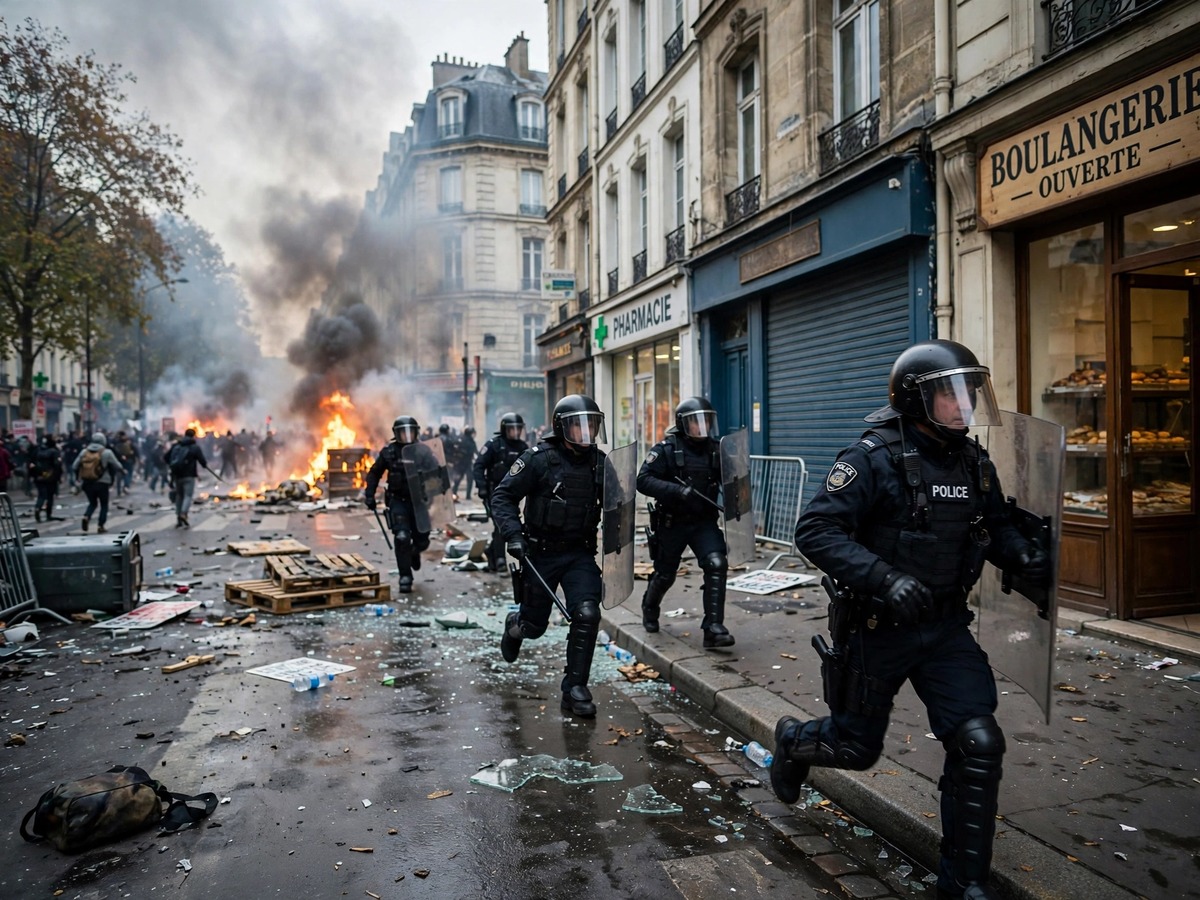
France’s Street Crisis Escalates
France is dealing with three pressures at once: far-left street unrest, severe fiscal trouble, and mass migration. Bloomberg reported Tuesday that 256,000 people demonstrated nationwide, including 56,000 in Paris. Nearly 500 people were arrested, bringing the total since September 28 to more than 6,500. Police used tear gas in some locations, and the report says 43 officers were injured earlier. Thousands of schools were partially or fully closed, while up to 40,000 people were expected at a protest in Paris. In Lyon, a circulated clip shows police being pelted with rocks and bottles. In Perpignan, another video shows high-school students arguing for smaller classes and better arrangements when teachers are absent. That contrast matters. A school grievance may be real, but once streets fill with fire, rocks, and riot police, the tidy press-release version of events starts looking rather underdressed.
The Official Story Meets the Footage
The official corporate-media explanation is that many of the young protesters want smaller classes, building renovations, and changes to university admissions. The report counters that social-media videos show rioters burning schools, while riot police use tear gas as closures spread. Other supplied posts show police intervening near Place de la Nation after a fire, officers making an arrest, and urban furniture burning during a Paris gathering. One post carries protesters’ accusations of sexual assault against CRS officers; the material supplied here does not establish those allegations. Another post features Palestinian flags and makes sweeping claims about foreigners and Islamists. Those claims are commentary from the posters, not independently established findings in the supplied report. In other words, the narrative is not merely students versus administrators. It is a fast-moving contest over what the unrest means, with every side trying to turn a chaotic street scene into a clean political message. Good luck with that.
Macron, Le Pen and the Debt Pressure
The pressure is also reaching the presidency and the markets. The source says Emmanuel Macron is losing his grip and that his approval rating has cratered, raising the prospect of a Marine Le Pen victory in next year’s presidential election. It presents the riots, fiscal weakness, and migration as one collision rather than three unrelated headlines. Traders have dumped French assets, including government bonds known as OATs, amid concerns about political instability. The report also reproduces a Truth Social post attributed to President Trump: “What’s happening in France is nothing less than out-of-control mass migration. This isn’t about schools, this is about Islam wanting to take over a once great Country!” Federalist senior editor John Daniel Davidson argued that France has a large population of young immigrants or children and grandchildren of immigrants who are difficult to employ, saying employers will not risk hiring them. He linked that problem to poor assimilation and long-term governability. Those are political arguments, but they show how quickly school protests can become a national fight over borders, identity, and leadership.
High-school students in Perpignan, France, convincingly make their case for smaller classes and better arrangements for absent teachers. pic.twitter.com/jkCyH9oGIZ
— Mark Higgie (@MarkHiggie2) October 5, 2026
The high school riots continue today in Lyon.
The police are being pelted with rocks and bottles pic.twitter.com/VvJtkKq8JG
— Visegrád 24 (@visegrad24) October 6, 2026
🚨 BREAKING: MASSIVE RIOTS and PALESTINE FLAGS are waving in Paris, riot police are STRUGGLING, foreigners are everywhere and leftists are going berserk
THIS IS AMERICA IF THE LEFTISTS WIN.
The Islamists are waving the Palestinian flag everywhere…FRANCE IS FALLING
TEAR GAS… pic.twitter.com/u0DEC5iZuu
— Eric Daugherty (@EricLDaugh) October 6, 2026
Riot police have fired tear gas at protesters in Paris after the demonstrations across the country saw thousands of schools partially or fully closed.
Up to 40,000 people are expected to be attending the protest in the French capital.
Read the latest 🔗 https://t.co/OO4R2ZBbVu pic.twitter.com/DpFzecxHyf
— Sky News (@SkyNews) October 6, 2026
Intervention de la police contre le cortège de tête près de la Place de la Nation à Paris suite a un départ de feu.#6octobre #BlocusLycées #BlocusUniversités #Paris pic.twitter.com/5POhENK2r3
— Luc Auffret (@LucAuffret) October 6, 2026
Students vs Police in Lyon, France #Paris #France #Riot #Internationalleaks pic.twitter.com/dxfvuMTW9g
— International Leaks (@Internl_Leaks) October 6, 2026
« Vous laissez vos collègues agresser sexuellement des jeunettes »
🚨 ALERTE – Des manifestants accusent les CRS d’agressions sexuelles place de la Nation pic.twitter.com/pAYqz44gww
— Frontières (@Frontieresmedia) October 6, 2026
🚨 La situation NE SA CALME PAS à Paris. Sur ces images, les CRS interpellent un individu. pic.twitter.com/9HvBlTr2YO
— Frontières (@Frontieresmedia) October 6, 2026
🚨 ALERTE – Du mobilier urbain en feu sur les routes lors du rassemblement à Paris. Les flammes sont alimentées par des manifestants. pic.twitter.com/phxQXBZcDl
— Frontières (@Frontieresmedia) October 6, 2026
— Rapid Response 47 (@RapidResponse47) October 6, 2026
The problem looming over these riots is that France has a large population of young people who are immigrants or the children/grandchildren of immigrants that are simply not employable. They will not work and employers will not risk hiring them.
They are not citizens in any… https://t.co/lqRjFMAU31
— John Daniel Davidson (@johnddavidson) October 5, 2026
it's been a while since we had a European sovereign debt crisis
*FRANCE-GERMANY 10-YEAR YIELD SPREAD WIDENS 8BPS TO 135BPS
France CDS widest in 13 years pic.twitter.com/9opJUmD2uS
— zerohedge (@zerohedge) October 1, 2026
Why It Matters
These events matter because street disorder, school disruption, fiscal pressure, and a migration dispute are reinforcing one another. Residents face closures and damaged public spaces. Students with ordinary complaints can see their concerns swallowed by arson, clashes, and louder political claims. Police must protect public order while handling demonstrations whose stated demands range from classroom conditions to broad arguments about national identity. The financial side matters too. When political instability unsettles French assets, a crisis in the streets becomes a test of confidence beyond the streets. That is an unpleasant way for a government to learn that slogans do not balance budgets.
The open questions are consequential. Can French authorities separate peaceful school grievances from violent acts? Can Macron restore enough authority to keep the next election from becoming only a protest against him? Will the migration debate produce policy, or remain a contest of accusations and viral clips? And can fiscal strain be contained while French assets are being sold? The source presents Le Pen’s possible victory as a prospect, not a settled result. That uncertainty is the point: the country is not facing one isolated disturbance, but a test of whether its political system can handle several pressures without turning each one into fuel for the next.
Source: The Liberty Daily
