
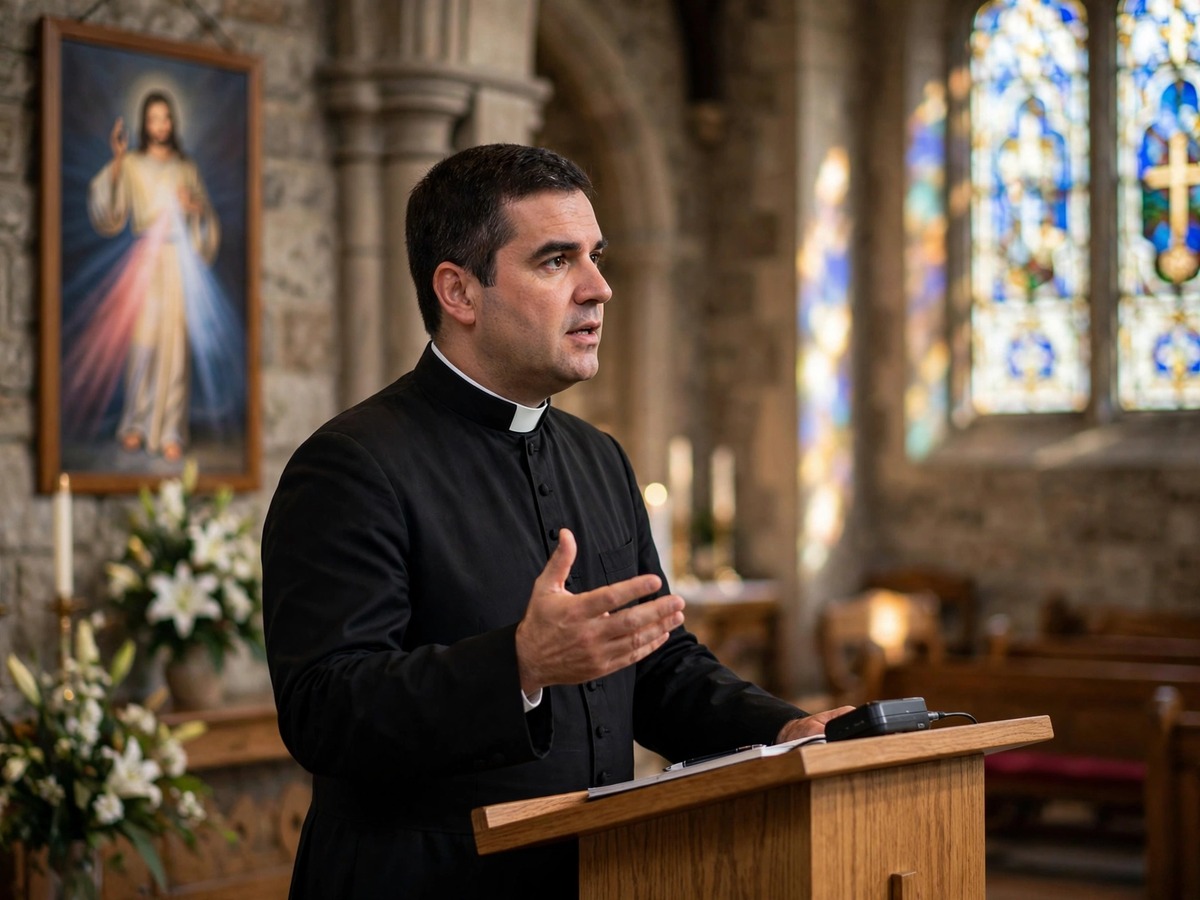
While most Catholic bishops and the Vatican hierarchy continue their endless “dialogue” with Islam, one priest just said the quiet part out loud.
“Muhammad is not God. He is not the Savior. As a matter of fact, he was a pervert and a pedophile," Father Donald Calloway said…
— The Gateway Pundit (@gatewaypundit) November 21, 2026
A Viral Clip Puts the Religious Divide in Plain Terms
Father Donald Calloway, MIC, an American Catholic priest, author, and Marian speaker, delivered remarks in a conference talk that have spread widely online. The Gateway Pundit says it has not independently verified exactly when the talk occurred, an important caution when a clipped video moves faster than its context. In the clip, Calloway states, “Muhammad is not God. He is not the Savior.” He then calls Muhammad a “pervert” and a “pedophile,” language that is plainly Calloway’s accusation and is highly offensive. He also argues that Islam lacks a moral foundation. His wider point is that Christianity and Islam make different claims about God, salvation, and morality. He rejects what he sees as endless dialogue when public discussion appears to soften or avoid the reality of Christian persecution.
Why Muhammad and Aisha Are at the Center of the Dispute
Calloway’s comments connect to a longstanding controversy about Muhammad’s marriage to Aisha. The source cites Sahih al-Bukhari 5134, which says Aisha was six when Muhammad married her and nine when the marriage was consummated. Some modern Muslim scholars dispute that chronology. Calloway treats the traditional account as evidence for his condemnation of Muhammad. A careful account should keep those steps separate: the cited tradition makes a claim, scholars debate its historical timing, and Calloway draws a moral and theological conclusion. The clip turns that historical and religious dispute into a blunt public challenge to Christian leaders who favor measured interfaith language.
Nigeria Brings the Argument Back to Persecution
Calloway then turns to Nigeria’s persecution of Christians, especially the kidnapping of children from a Catholic school. He says, “What just happened the other day? … 300 children were just kidnapped again from a Catholic school in Nigeria.” The Gateway Pundit’s earlier reporting identifies a November 21, 2025 abduction in which armed gunmen took 303 schoolchildren and 12 teachers from St. Mary’s Catholic School in Niger State. It also reported in April 2026 that at least 145 Catholic priests had been kidnapped and 11 killed in Nigeria between 2015 and 2025. The source presents these events as part of the case that religious extremism is being downplayed. Calloway rejects explanations that reduce the violence to agriculture, asking, “Are you high?” before accusing leaders of ignoring what he sees as clear religious persecution. The grief behind these numbers is not theoretical. Families, students, teachers, and clergy have paid the price, and public debate should not erase them.
His Answer Is Prayer, Conversion and Public Faith
Calloway says his answer is not violence. He calls for prayer, spiritual conversion, and public Christianity. When he speaks of “unsheathing the weapon,” he is referring to the Holy Rosary, then adds, “not to do harm to anybody.” He also describes an extraordinary wish: that the Blessed Virgin Mary would appear above the Kaaba in Mecca holding the infant Jesus and a rosary, leading Muslims to voluntarily embrace Catholicism. Finally, he criticizes Christians who feel embarrassed to make the sign of the cross before eating in a restaurant, contrasting that hesitation with Muslims’ public prayer. He says Christians are “so wimpy.” His message is aimed in two directions: against Islamic doctrine as he understands it, and against Christians he believes have surrendered public confidence in their own faith.
Why It Matters
The stakes are larger than a quarrel over religious vocabulary. Calloway is pressing a question that church leaders and believers must answer: can calls for dialogue coexist with a plain description of persecution when Christian families, students, and clergy are suffering? The answer matters to people who want their safety concerns acknowledged rather than folded into vague language about local conditions. It also matters to leaders whose words shape whether victims feel seen or dismissed.
Public criticism of Islam carries its own responsibility. Strong language may rally Christians who feel abandoned, but it can also blur the difference between condemning doctrines, judging disputed historical claims, and treating ordinary Muslims as a single group. Calloway says his answer is prayer and conversion, not violence. That distinction is important, especially when a short online clip can remove the surrounding explanation and leave the harshest words doing all the work.
The open questions are difficult. How much of the violence in Nigeria is driven by religious extremism, and how much by other pressures named by church leaders? What response protects Christians without inflaming wider tensions? Can church institutions speak clearly about persecution while still rejecting collective blame? The source offers no final answer. It records a sharp challenge to leaders who prefer careful language, and to believers who may be reluctant to live their faith publicly. The clip leaves those questions hanging.
Source: The Gateway Pundit
