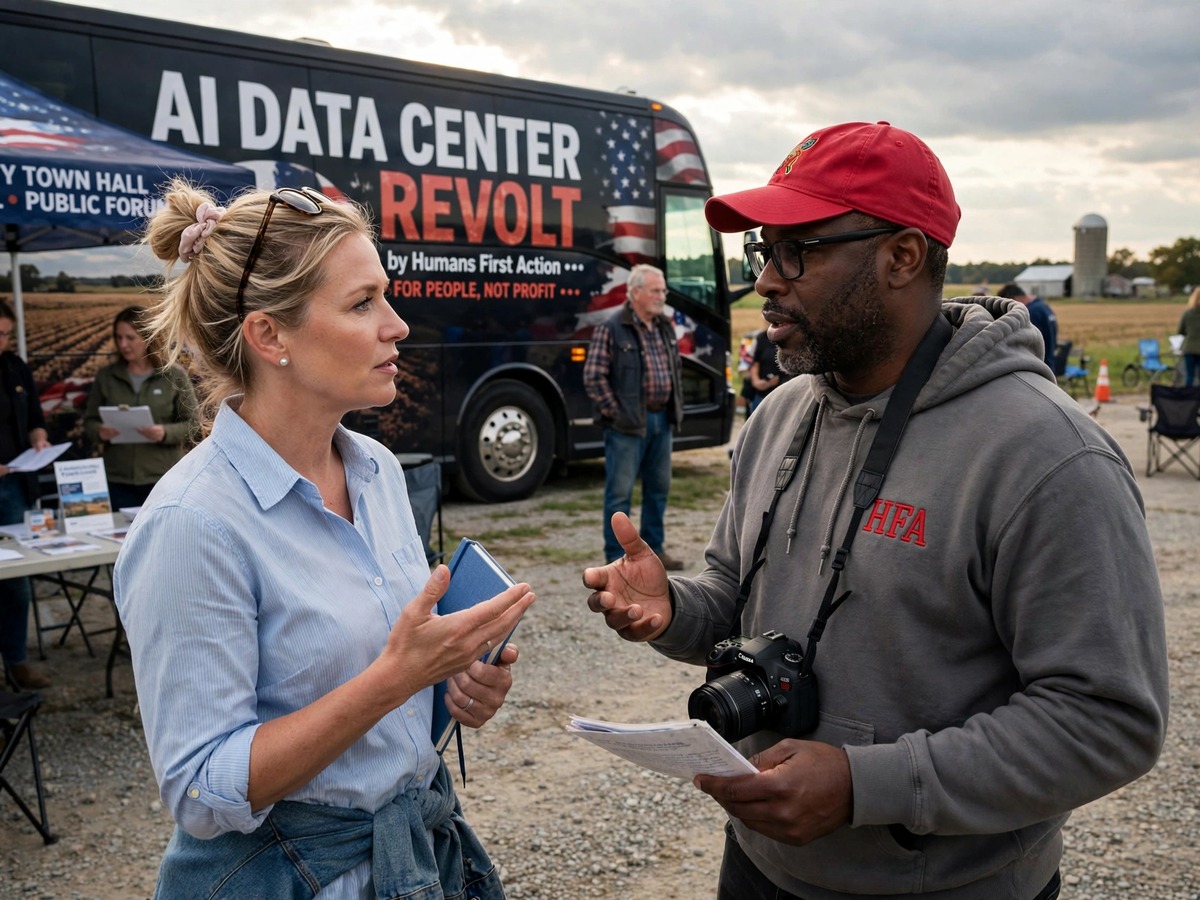
The Question Following the Tour
Humans First chair Amy Kremer has been speaking with reporters during the Data Center Revolt Tour, where residents keep raising the same basic questions: Who is behind these projects, what is known, and what is still only a projection? The tour’s earlier stops focused on people living beside the expanding data-center buildout, including residents in Iowa, Kansas, Pennsylvania, Virginia, and other small communities. But as the bus moved from town to town, another question kept returning: How does this whole system actually work? Data centers are being proposed well beyond Silicon Valley, including in rural towns, farming communities, and small counties that never expected to become part of the artificial intelligence economy.
The Site Can Come Before the Customer
Many people picture a simple process. A technology company decides it needs a data center, hires a developer, chooses a site, builds the facility, and moves in. Sometimes that happens. Another model begins with the property itself. A developer may buy land, place it under option, or secure another form of site control. Then the developer works to remove the problems that could scare away a future customer, including zoning uncertainty, weak power access, missing fiber, water and cooling questions, road access, environmental permitting, engineering, and construction concerns. Each problem that gets solved can make the site more valuable. The developer may not be building for a specific company yet. It may be building a platform that a future company can use.
Power Is More Valuable Than Dirt Alone
The most important ingredient is increasingly deliverable power, not simply acreage. Data centers are the physical backbone of cloud computing and artificial intelligence, and they require land, enormous amounts of electricity, transmission infrastructure, cooling capacity, fiber connections, and, depending on the design, substantial water. They also require extraordinary amounts of capital. That helps explain why projects can move at a speed that looks almost incomprehensible from outside the industry. A developer may know the basic development envelope before knowing who will occupy it. That envelope can include the acreage, the approximate number and size of buildings, maximum electrical capacity, substation locations, utility corridors, setbacks, roads, buffers, and a general development schedule.
Why Detailed Plans Can Still Have an Unknown Tenant
The future tenant may decide what happens inside that larger envelope. Rack density, chip architecture, cooling technology, actual water demand, electrical configuration, interior fit-out, and the pace of occupation can all depend on the eventual customer. That is why a community may see drawings for multiple buildings, projected tax revenue, power requests, and water estimates while also being told that the final end user has not been identified. That situation is not automatically a contradiction. It is a clue to the development model. The outside structure and infrastructure can be planned first, while important operating details wait for the company that eventually signs on. The explanation does not answer every local concern, but it does make the sequence easier to understand.
From Site Control to Public Decisions
The process usually begins with site control through a purchase, an option, or another agreement that gives the developer the right to pursue the property. Feasibility work follows. That includes examining power, transmission, fiber, cooling, water availability where needed, environmental conditions, road access, and engineering. Then come the public decisions, such as rezoning, special-use permits, annexation in some communities, utility agreements, development agreements, tax incentives, and other permits. As those risks are reduced, the site becomes more useful to a future customer. What looks like one giant project to residents is therefore built through a series of steps, with the property becoming more prepared before the final occupant is necessarily known.
Why It Matters
This distinction matters because residents may be asked to evaluate a major campus before the identity of its future customer is settled. They can see the land, proposed buildings, and expected infrastructure demands, but some practical details may depend on whoever eventually occupies the site. In plain terms, uncertainty is part of the business model. It does not automatically mean the drawings are meaningless, but it does mean that a detailed plan may not tell the whole story.
The stakes extend beyond a developer’s paperwork. Zoning, roads, power, fiber, cooling, water, and environmental questions are dealt with in the communities where these projects are proposed. A property that becomes more valuable as obstacles are cleared can also become harder for residents to judge in simple terms, because it is changing from raw land into a ready-made platform. That makes clear explanations and careful public decisions important when projections may look more settled than the customer details actually are.
The open questions remain the ones heard along the tour: Who is behind a project? What is known now, and what is still a projection? Which details will the eventual tenant change? The development model explains why a detailed plan can come before a named customer. It does not settle every question about power, water, cooling, or the public agreements needed to move the plan forward. That gap is where local scrutiny begins, and where polished project plans meet the realities of small-town communities.
Source: The Liberty Daily